One of the interesting accounts in Daniel Kahneman’s book “Thinking, Fast and Slow”, is a combination of two things: First, a description of the reasons why certain types of planning don’t work because of limitations in the human mind, and how to work around that. Second, the account of a bunch smart folks working together on a project, and making those very mistakes. I think this raises a very interesting, and possibly fundamental, question about reality.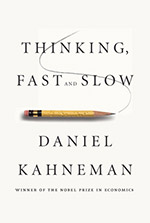
Kahneman’s book is about two cognitive systems that structure the way we think. It shows, for example, when and why we cannot trust our quick intuitive thought processes, and how to tap into the slow processes to counteract our intuition in such cases. In many ways, what he describes are fundamental limits to the human mind, and he brings this out in the discussion of strategy and planning, to show how planning generally doesn’t work because of inherent biases when viewing something from the “inside”. By recognizing this, it’s possible to devise a strategy to work around it that involves views based on outside perspectives.
The description of these effects includes a great example. In it, a group of people, including Kahneman and other world-class scientists, come together to work on a project. In doing so, they estimate the effort and time required to execute the work. Now, you might think that these people, who are among the world’s experts at the workings of the human mind, would rise above its limitations and plan accordingly. Unfortunately, that’s not what happened.
Instead, these experts found themselves behaving just the way anyone else would behave. If you read the book, you can see how this happens, for the influences described in it are amazingly subtle, even subconscious. So, even understanding that, it’s all too easy to fall prey to them, and that’s what happened in the group. An interesting dilemma, for if they could not rise above their own human limitations, is it reasonable to expect anyone to?
Even if this were possible in small measure, the challenges faced by the great problems of human behavior require more than momentary insights beyond normal human thinking. If one looks honestly at the world around us, we see a few advances in structured society, vast advances in technology, but no real change in human nature.
The question arises then, of whether it is possible to design social and economic systems that work well for humans, if humans are doing the design. While cognitive science is developing better and better models of how we think, application of those models may be challenging on the scale necessary to develop complex, discipline-spanning solutions.
The intent is not to sound a negative alarmist note, but to explore whether there is some sort of fundamental limitation, sort of a cognitive version of Godel’s theorem. There, it’s impossible to prove every theorem within a sufficiently complex mathematical system. So one has to rise above, or step outside, the system in order to determine if certain theorems are true.
What if it were impossible to design a perfect system from within, as we are forced to do? Are we doomed to repeat the same mistakes over and over, perhaps very slowly moving forward, but then resetting from time to time? Could it be that, somewhat like Godel’s theorem, we need an answer that comes from outside?
Perhaps an innate knowledge of this limitation is why heroes are so popular, why we tend to look for a savior. We know, deep down, that there are fundamental limitations to what we can achieve, and so we realize that giving all people a truly successful and fulfilled life can only be achieved by working beyond those limitations. As a result, we are drawn to look to forces beyond human.
As a Christian, this observation makes perfect sense. I know that there is a love beyond merely human, with the power to shape reality, that is drawing us to him. He desires the best for us. Because he works from an eternal perspective, it is sometimes difficult for us to see that, almost like the limits to our cognition. Yet, like Godel’s unprovable theorems, our lack of understanding doesn’t make it not true.
 Kelvin's Clouds