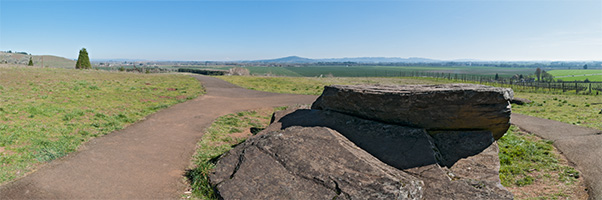
 This is the view from Erratic Rock State Natural Site near McMinnville, Oregon. The large rock in the foreground originated in the northern Rocky Mountains, nowhere near this spot. It is the only rock of its type outside Canada, and was transported here during a massive Ice Age flood around 15 thousand years ago. Titanic floods washed down eastern Washington, scoured their way through the gorge, then filled the valley with water. The water was filled with debris including icebergs from the flood’s origin, some of which carried boulders. As the ice melted and the waters receded, this boulder remained, a silent testimony to the power and extent of the flood. The view from this point helps us appreciate the scale of the flood.
For an interactive view of this location that more fully reveals the expansive vista, see this post. As you look out over the valley, try to imagine the vast scale of this catastrophic event, the amount of water needed to fill the valley before you, the forces powerful enough transport a 90-ton boulder across hundreds of miles.
And yet, as you stand there awed by the scale and power involved, remember that this is but a small event in the scale of the entire planet, only a small puddle of water trickling from one spot to another. On the scale of the solar system, the pool becomes a drop, and on the scale of the universe, the entire event becomes nothing. As awe inspiring as this ice age event is, it is inconsequential on the cosmic scale. As small as we may feel when faced with the enormity of the event, how much smaller we seem against the scale that dwarfs even that.
The same might be said for the timescale. As much as we marvel at structures that are ancient by the standards of humanity, perhaps even millions of years old, this is but a blink over the time of a 13 billion year old cosmos.
Staring up at the stars at night, seeing the vast scale of both time and space, one cannot help but ask: Who are we, to imagine ourselves significant on such a stage? Our grandest constructions mere dust, entire civilizations mere flashes. It seems we are just fleeting chemical reactions that think much of themselves.
And yet, we are significant. A person is worth more than any amount of inanimate matter, something we recognize deep in our fundamental nature.
Why is that so? Why do we value life, and human life in particular, so highly? Is it just appreciation for our special complicated chemical reactions, or is there something more?
Perhaps the key lies in something more than the physical. Perhaps the universe we see is only a part of the whole — the temporary, time-bound part that stems from an unseen timeless reality.
Imagine that our true nature originates in that unseen reality, and the human value we recognize is a reflection of that timeless nature. Perhaps our nature is even an image of the force that willed this physical experience into existence. The creator had a purpose for the universe, which means we have a purpose, and because of that we have a value beyond the physical. But I think the truth may go even beyond that.
At the cosmic scale, the creator becomes an abstract, unfathomable entity. Even if he created us, it seems hard to believe our little existence would be worth his time when the rest of creation beckons. But this is why his incarnation is so meaningful. This is the Christian concept of the creator acting in love, so identifying himself with us that he was born, lived, and died as one of us. Yet even though he thoroughly identified with us, he was still the pure source of life, and so exhibited none of our flaws. Because of that, his death was special, and ultimately reversed.
The reversal of death shown in the resurrection points to the power behind creation. It is a picture of the limited nature of chemistry being overcome by the limitless power of the creator. Not just a religious symbol, it is a reality, a singularity that represents the unseen personal gateway to that power, established through the incarnation, to make a connection between our flawed nature and the one who defines flawlessness. Our creator stepped into our world to rescue us from a life dominated by temporary physical purposes, into a life determined by timeless ones.
The result is less about living forever, than living a fulfilled life now. Not about avoiding some future punishment, but avoiding today’s pointlessness. Ultimately, we have worth because the one who created us loves us and declares us worthy. We can love each other by recognizing that worth.
No matter how small we may feel when standing awestruck under the starry canopy, we can know there is value and meaning to our lives because the creator says there is, and he can lead us along the path to realize it.
So as you look out over the vast scale of that flood, know that you are important.
 Kelvin's Clouds