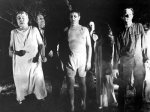
 In the continuing comparison of natural and supernatural views of reality, we’ve considered some fairly philosophical perspectives. However, for these things to be real, we would expect clear manifestations, some evidence in the natural world. It may or may not be strictly testable, but there should be some ramification. In this essay, we’ll consider an example of what we might expect, drawn from a movie.
The movie of interest, I Am Legend, is not a Christian movie. In fact, it is a secular mass market zombie movie made by mainstream Hollywood. Surprisingly, however, they use several Christian themes as plot elements and we can draw on those to illustrate the point a hand. (Warning: This post contains SPOILERS.).
Often, people expect divine intervention to take the form of an outright miracle, fantastic coincidence, or profound visionary visitation (complete with dramatic light show and music). In this case, we see something much more personal and human.
In this movie, Dr. Neville has been racing to find a cure for the zombie virus when he is rescued from a tight situation by a Brazilian woman named Anna. As they prepare to defend themselves against the zombie horde, Dr. Neville tries to understand her plan, and her statements surprise him.
(Note, these clips contain massive SPOILERS and some intense scenes.)
To explain her plan, Anna claims to be hearing from God. Incredulous, Neville refuses to believe her, and focuses on a rational explanation. At this point, it seems clear that their meeting was simply a combination of luck and Neville’s broadcasts.
However, as the final climactic scenes play out, it becomes clear to Neville that their chance encounter is profoundly more significant than he originally thought.
As the zombie horde closes in, he prepares to sacrifice himself to save Anna and Ethan, and echoes Anna’s words as the reason for his actions:
“I think this is why you’re here.” … “I’m listening”
Neville acknowledges that something is at work to bring hope to the rest of mankind, and that he needs to listen to that guidance himself. Neville’s sacrifice ultimately allows Anna and Ethan to continue their journey, and the movie concludes with a strong confirmation of Anna’s statements.
Encountering Neville could have been luck, but with no other information given, we’re left to understand that the plan she was given also led her to the survivor community.
No dramatic miracles or light shows, just simple guidance and trust. Although most of what we hear about religion seems to concern politics and sociology, the picture here is that those who know God relate to him personally, not in some abstract religious way. Personal interaction involves communication, just as it does with all other relationships.
Now, encounters like this can take many forms. While some may seem to be nothing more than luck, like Anna’s initial encounter with Neville, others may be far more incredible, like Anna finding the secure community. Even the latter isn’t really proof of anything, but many such events, especially across a diverse cross section of cultures and involving sophisticated thinkers, provides some level of evidence. Evidence is not proof, but it is a reasonable starting point for seeking deeper understanding, especially since there is not enough contradictory evidence to rule out spiritual possibilities.
The choice is to either explore with an open mind, or take the easy psychological shortcut of believing that what we see is all there is.
The most common approach is to take the easy path and employ a common mental quirk called confirmation bias. It allows us to see only what agrees with what we want to believe. In this way, although there may be millions of experiences like those illustrated here, explaining a few of them away allows the mind to categorically reject them all without critical thought, no matter how different and credible others may be.
This blog attempts to avoid such error, explore these perspectives more carefully, and see if there isn’t a rational and reasonable approach to exploring faith, rather than one determined by tradition or popular thinking.
My belief, which this video illustrates, is that logic and reason are no more sufficient (on their own) for building supernatural relationships than for natural ones. In other words, the insistence of making this debate only an intellectual argument is as wrong as trying to experience human relationships like a computer program. This error exists both inside and outside faith systems. It seems we need to strip away the dogmatic thinking in both arenas (whether religion or logic), and learn to explore things in a relational manner, as we do the other important aspects of life.
 Kelvin's Clouds