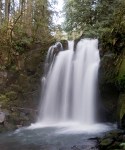
 Simple virtual reality (VR) photographs, sometimes known as spherical panoramas, are all around us. A few years ago, they were novelties used in special effects productions, advertising, and other niche applications. Now they are frequently used in common applications like Google Street View, games, Facebook, and so on, and smartphones provide an easy way to view them. Specialized hardware can even be used to extend the effect to 3D, but the basic idea of looking around the inside of a sphere remains a useful variation of the standard flat picture.
I dabble with making VRs for fun, especially of waterfalls, because doing so reveals other beautiful things. As scenic as most waterfalls are, they are often in surroundings that are also striking. Lush canyons, austere cliff faces, and so on. When we take a single still picture, the surroundings are rarely included. By taking a VR, other elements become visible. It’s as if you are there, and can look around and appreciate the whole environment.
In almost any situation, VRs capture a more complete, and in some ways more honest representation of a scene. This has been used in journalism, for example. When taking a standard picture, simply framing the shot is an editorial decision. What to include versus what to leave out influences how the viewer responds, what they learn, and so on. This sort of thing can have profound influence on how one interprets a scene. Even if all someone wants to do is provide information, the simple act of framing changes how the information is interpreted. Perspective is important, and VRs illustrate that.
For example, our natural belief is that human senses reveal the world correctly, leading us to believe that what we see is all there is.* Unfortunately, it’s been shown many times that the way we see the world is often wrong, and we can even miss things that are right in front of us.
A great example (spoiler!) is the “invisible gorilla“. In a classic experiment, test subjects watch a video of people playing basketball, and are told to focus on a particular aspect of the scene. During the video, a person in a gorilla suit walks into the midst of the players, pounds its chest, then walks out of the scene. Amazingly, about half the people who watch the video never notice the gorilla.
It seems incredible that something so obvious could be missed. Yet when our focus is very narrow, we can become blind to everything else. It takes deliberate effort to keep an open perspective.
Now, if it is that easy to miss things right in front of us, imagine how much easier it is to miss things that require looking around. This is the VR metaphor: We are given a starting viewpoint into a scene, but must deliberately act in order to see more — we have to want to look around. Without that desire and effort, we not only see less, but believe that less exists. That is the mistake that our minds easily make, and we can become jaded over time, unwilling to look around, focusing on just those details that justify our favorite view.
Science extends our senses, allowing us to “see” things that our natural senses cannot, but we automatically extend that mental mistake at the same time. The fact is that our our understanding of reality, especially regarding human experience, is incomplete and still full of hard problems.
Now if we are so susceptible to this with the natural, how much harder must it be to consider the spiritual.
Now, it’s common to accuse religious people of behaving irrationally, and seeing things that are not there. There are similar cognitive errors that come into play in those instances. But the real point is, if these errors are so ubiquitous in both cases, then we shouldn’t assume that only believers are wrong. The world is still full of things we don’t understand and can’t explain. We see the recent successes of science and technology and believe reality is completely worked out — that’s all there is. Or we see a few unexplained coincidences and think the world is full of ghosts.
In either case we can become jaded and refuse to continue exploring.
Not sure exactly how this guides photography, but I sometimes keep it in mind when making a VR. In a way, it serves to remind me to keep my mind open to things that aren’t immediately apparent. There are some things in our world that are apparent only when we open our eyes to see them.
* There’s even an effect that goes by this name, it is such a striking mental phenomena. See the book “Thinking Fast and Slow” by Daniel Kahneman, and this blog post.
 Kelvin's Clouds