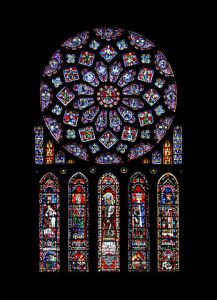
 While taking a picture recently that included some beautiful stained glass windows, I learned how difficult it is to make a good picture. The back light through the windows makes it challenging to capture an image that blends with the rest of the scene. The key seems to be balance between the front lighting and the back lighting. If either one is too strong, the result is not beautiful. With only back lighting, the colors are beautiful, but the context of everything is gone. With only front lighting, the picture is clear and balanced with the context, but much of the beauty is gone.
This brought to mind the interplay of the physical and the transcendent, and in particular, how they intersect in the human mind.
There is a new field of research that I’ve been learning about, related to exploring cognitive aspects of religious experiences. The work generally starts with the assumption that there is no transcendent reality, and seeks to explain all related experiences in terms of physical phenomena. Simplistically, the idea is that affecting the brain affects how we think, and affecting the brain in certain ways seems to relate to spiritual experiences. Thus, it must be possible to explain all religious experiences this way.
However, it seems this could run into the same error that our imbalanced window could produce. In that case, by focusing on just the front lighting, the window seemed to be part of the environment — so much so, that it lost the special quality that stained glass windows have. Similarly, just focusing on natural perspectives may produce an incorrect perspective.
Consider the window, and suppose we wanted to understand the extraordinary glowing appearance, but we assumed that there was no such thing as backlighting. If we covered a pane and the glowing aspect disappeared, we might reasonably suppose that the glass itself was glowing. Similarly, if we modify the brain, through injury or chemicals, and observe that its extraordinary aspects change, should we conclude that they were all due to just the brain?
In both cases, how do we tell the difference between there being only a physical explanation (just the glass or just the brain), and there also being a nonphysical aspect (backlighting or transcendent reality)?
With the glass, we can try other experiments such as removing a pane entirely, that may not have reasonable parallels with the brain. We can also make measurements of the light itself, but there’s no comparable measurement technique for thought or awareness. It can’t be detected using physical machines; we need something different.
Just as science is good at dealing with the physical realm, perhaps we need something that at least interacts with the non-physical, even if we don’t completely understand it. So, what if we probed it with something else, like beauty?
Consider the beauty of a stained glass window. Beauty goes beyond the mere physics of glass and photons; it goes deeper.
Look at a radiant stained glass window, and what do you see? Color, light, form? Do you notice the environment? What else is there to observe? One thing to notice is the observer — beauty exists only because there is someone to behold it. There is a mind, a self-aware consciousness.
The beauty is real, but only as real as the mind perceiving it. Look in a mirror; how real is the mind that sees the reflection? How real are you? Not your physical body, but the awareness looking out through your eyes.
It seems the question comes down to whether your experience is just some complicated chemical reactions, or an awareness that goes beyond the merely physical. I think the reality of beauty goes beyond chemistry; what do you think?
Photo was taken by Eusebius (Guillaume Piolle). Own work, Public Domain, https://commons.wikimedia.org/w/index.php?curid=5945611
 Kelvin's Clouds