 Here is the start of a a framework for exploring photography. I’ve dabbled with photography for years, but have been unsatisfied with the results. Not necessarily aesthetically, but personally. It’s not that I could never produce pictures that were visually attractive, but they just didn’t do anything for me. Or else, I found myself unmotivated by them.
Basically, I found that the fun, and even the challenge, of simply making nice looking pictures wasn’t motivating. This realization may have come about from starting with virtual reality photography. Although I tinkered with standard photography, most of what I made were spherical pictures (virtual reality photos, or VRs). Something was missing, but I still felt drawn to explore it.
There are several ways that VR photos are richer — they reveal more context because they show everything in a scene, interactivity is a fundamental part of the viewing experience, and composition guidelines are different. Regarding this last point, some guidelines may not apply at all, or they may apply but work differently. For example, symmetry is still valuable, and means much the same thing. But leading lines, often used to guide the viewer’s gaze to a specific spot, could also be used to lead viewers outside the scene and encourage them to look at other parts of the VR sphere. In addition, there may even be completely new guidelines to explore with VR photography itself, and these may in turn suggest new approaches to standard photography. These considerations open up a range of new possibilities and promote new ideas, leading to expressions of creativity.
Thinking about this resulted in an interesting sequence: technique to creativity to VR photography.
However, I don’t think VR photography itself is the point. Context, interactivity, and composition are all interesting aspects of VR, but the thing that attracted me in the first place was the way VR photography could convey meaning, using all those things, by being a metaphor for insight. In other words, charting a path from technique to creativity doesn’t lead to VR photography, it leads to meaning.
In that case the sequence becomes: technique to creativity to meaning.
This seems like a great framework to explore. We can make photos with good technique, grow creative expressions, and strive to convey meaning. To be honest, though, I don’t really know what is increasing in the sequence. There does seem to be an order, some logical progression, but what is progressing?
At any rate, whether or not I understand why this sequence works, it seems worth exploring. Taking each of the steps, and seeing what can be learned.
Technique is the mechanistic aspect of photography. It’s important, and one can have good results just by mastering even one technique. Building on what has gone before, because the whole idea of standard techniques is that they capture what has been tried before and found to work. For me, this gives a focus for practicing and learning, and is a starting point for exploration.
Creativity goes beyond technique by looking for new things, rather than using what is well-known. Seems like this gives more opportunity for personal expression, by coming with something new, by definition it is ours since no one else has done it before.
But novelty for its own sake can only go so far. If a photographer wants the creative work to truly be a personal expression, then it needs to say something about who they are, what they have to say. It needs to convey meaning. This goes beyond the picture itself and brings in a larger context. Meaning establishes a dialog between the artist and the observer.
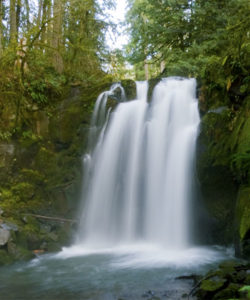
In my own work, this three-piece framework of technique-creativity-meaning seems fruitful. For example, I like to photograph waterfalls. Standard techniques include things like long exposure, typically resulting in something like the picture at the beginning.
Another standard technique is to avoid bright direct sunlight and the harsh reflections that result. However, in an exploration toward creativity (hopefully), I tried focusing on the very thing that we’re supposed to avoid: the direct reflections. A quick attempt at this resulted in a series of pictures I called “Glint”:
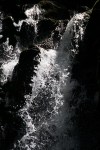
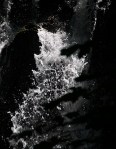
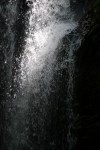
While the result was bland, the unexpected dark and abstract nature was more interesting than expected. So in a followup experiment, I pushed some of those aspects, and created this picture:

This is a little more interesting, and made me think of moments of “aha” insight where the light of insight breaks through the darkness of confusion and uncertainty. This meaning is now something to explore. In general, there are various aspects of waterfalls that are interesting and exploring through these artistic dimensions becomes a dialog. Why do I find them interesting? What am I trying to say?
With all of this, photography works through these three facets: Learning technique, creating new things, and discovering meaning. It’s a journey, as much about learning about myself as about learning the craft.
 Kelvin's Clouds