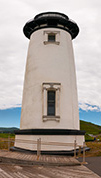
 In a recent photography project, I explored the idea that the way we look at something affects how we interpret it. This is similar to an earlier project that explored the importance of viewpoint, a related topic. In both cases, our personal biases and ways of looking at things influence what we see and how we understand it. It takes deliberate effort to try different perspectives, something that doesn’t come naturally. Yet, some of the most important things in life demand that we do this. For example, understanding someone else’s point of view can greatly strengthen a relationship. The deliberate effort pays off by helping us navigate something that’s inherently complex and subject to misinterpretation. Continue reading
Tag Archives: religion
Stained Glass and the Mind
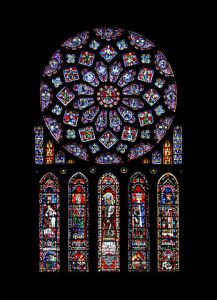 While taking a picture recently that included some beautiful stained glass windows, I learned how difficult it is to make a good picture. The back light through the windows makes it challenging to capture an image that blends with the rest of the scene. The key seems to be balance between the front lighting and the back lighting. If either one is too strong, the result is not beautiful. With only back lighting, the colors are beautiful, but the context of everything is gone. With only front lighting, the picture is clear and balanced with the context, but much of the beauty is gone.
This brought to mind the interplay of the physical and the transcendent, and in particular, how they intersect in the human mind. Continue reading
VR Photography as Metaphor
 Simple virtual reality (VR) photographs, sometimes known as spherical panoramas, are all around us. A few years ago, they were novelties used in special effects productions, advertising, and other niche applications. Now they are frequently used in common applications like Google Street View, games, Facebook, and so on, and smartphones provide an easy way to view them. Specialized hardware can even be used to extend the effect to 3D, but the basic idea of looking around the inside of a sphere remains a useful variation of the standard flat picture.
I dabble with making VRs for fun, especially of waterfalls, because doing so reveals other beautiful things. As scenic as most waterfalls are, they are often in surroundings that are also striking. Lush canyons, austere cliff faces, and so on. When we take a single still picture, the surroundings are rarely included. By taking a VR, other elements become visible. It’s as if you are there, and can look around and appreciate the whole environment.
In almost any situation, VRs capture a more complete, and in some ways more honest representation of a scene. This has been used in journalism, for example. When taking a standard picture, simply framing the shot is an editorial decision. What to include versus what to leave out influences how the viewer responds, what they learn, and so on. This sort of thing can have profound influence on how one interprets a scene. Even if all someone wants to do is provide information, the simple act of framing changes how the information is interpreted. Perspective is important, and VRs illustrate that. Continue reading
A Flickering Metaphor for Spiritual Vision
 Imagine a vertical line of LEDs in front of you. They seem to be partially lit, flickering slightly. To the left and right of the line are individual LEDs, periodically flashing back and forth. As you look over the scene, images appear for a moment. However, the more you look for them, the more you concentrate on seeing them, the less they appear. Continue reading
A Thought Experiment of Two Realities
 Sometimes we become so used to the way things work that we don’t even realize when there are options. Yet simple thought experiments can reveal possibilities that we would never see if we just rearrange normal daily experiences. In this essay, we’ll consider such a thought experiment to see what we can learn about relationships and the way all living beings interact, and consider what it might look like to turn a fundamental aspect of life upside down. Continue reading
Seeing Through Concrete
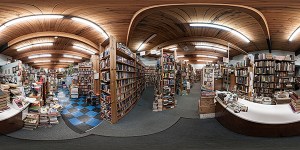 I recently took a virtual reality picture of a local bookstore (click on the picture to see it). It was for a worldwide virtual reality photo project with the theme “concrete”. I used the picture of the bookstore to highlight the concrete nature of physical books against the ephemeral nature of ebooks. This comparison also made me think of the concrete nature of the material world relative to the spiritual, so that this picture makes a good illustration. Continue reading
Zombies and the Spiritual Life
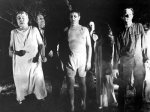 In the continuing comparison of natural and supernatural views of reality, we’ve considered some fairly philosophical perspectives. However, for these things to be real, we would expect clear manifestations, some evidence in the natural world. It may or may not be strictly testable, but there should be some ramification. In this essay, we’ll consider an example of what we might expect, drawn from a movie.
The movie of interest, I Am Legend, is not a Christian movie. In fact, it is a secular mass market zombie movie made by mainstream Hollywood. Surprisingly, however, they use several Christian themes as plot elements and we can draw on those to illustrate the point a hand. (Warning: This post contains SPOILERS.). Continue reading
My Theistic Framework
 For the past few years, I’ve been pondering religion “versus” science issues and have worked out an initial attempt of what seems reasonable to me. This post summarizes the ideas as a starting point for more detailed exploration, both with study and discussion with others. The basic idea is that it is a finely balanced choice, more finely balanced than most like to admit. The goal here is to be able to articulate why to make a particular choice, rather than just say “It’s how i was raised”, or “I like this”, or “I don’t like that”, etc. It’s an attempt at a rational perspective. Continue reading
Seeking a Balanced View of Science and Faith
Throughout human history, mankind has looked to the supernatural to explain things that seemed mysterious. There was a lot of motivation for this, because much of the unknown seemed dangerous — maybe invoking the supernatural could bring benefit in the natural realm. However, as knowledge of the natural world became more and more complete and successful, there seemed less and less need for the supernatural. For many, it became interesting, but not important.
Yet needs and fears didn’t really go away, they changed. We no longer fear the dark, but fear uselessness and hopelessness. We no longer struggle to find food, but still struggle with the need for love and relationship. We seek to understand the unknown instead of fearing it, but also seek a basis for right and wrong. And so religion has persisted, itself evolving from mere dogma to something more transcendent, still claiming to shine a light on these persistent aspects of being human.
So now we are faced with a question: Has science provided enough of a solution, or is faith still the answer for such fundamental needs? Continue reading
Proof, Evidence, and Faith
A friend recently wrote an essay discussing faith. In it, he gave one of the standard definitions of faith as “A belief that is not based on proof.” The common understanding is that religious beliefs are examples of this, especially since religions tend to use the same word in related (although not identical) fashions. I think this is a good working definition for discussing matters of science and faith, but want to explore how it may miss some subtleties in how we really approach beliefs. Continue reading
 Kelvin's Clouds