In an earlier post, I wrote about reading the Bible through its threads. The idea was that certain themes come through clearly even when individual passages do not, and even when some things don’t seem to fit. Here I want to approach that idea from a more abstract angle, by way of how technical fields deal with noisy data.
When we take measurements of a physical system, the data are sometimes noisy: the measurements vary more than we would expect. We may anticipate a straight line or a smooth curve, yet the points we actually record seem to be scattered all over the place.
Even then, careful mathematical analysis can reveal the line or curve that underlies the data. Techniques such as least-squares regression can isolate that underlying behavior even when the noise is substantial.
Consider the figure below.
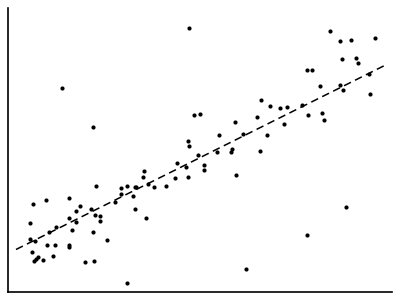
The data are clearly noisy, but the dashed line, fitted using one of these techniques, captures the trend that seems to govern the system’s behavior. Most of the points cluster around that line, though a few lie far from it. Despite the scatter, it is entirely possible to draw conclusions about the underlying system and to do useful work with them; engineers and scientists do this all the time.
Ideally, we would want to know what causes the noise and whether it needs to be addressed. But it can still be reasonable to design a system that relies on the linear behavior without fully understanding the spread in the data.
The point is that the line represents something real about the system, and that reality is not invalidated because some points seem to disagree.
This is one way I think about the threads described in my previous essay. Certain things are expressed throughout scripture, across different cultures and eras, and illustrated in many different ways. To me, these are like the trend line in the graph: a truth about the system that is not invalidated because some of the points disagree. It is only an analogy, of course, but I think it illustrates the principle well.
Love is one of those threads. It runs through scripture in a way that reflects a fundamental truth about Christianity, and the fact that some passages seem not to fit with it does not necessarily invalidate that truth. This is especially so given the uncertainties involved in interpreting the Bible.
The thread also extends beyond scripture, into the early church and, arguably, into the development of Western society. Disagreements exist in many places, and the church itself has not always lived up to its own teaching about love. Yet the thread remains.
The analogy also suggests how to treat the points that don’t fit. A good analyst doesn’t erase outliers or pretend they aren’t there; they are worth investigating, and sometimes they reveal something important about the system. But neither does the analyst let a handful of stray points overturn a trend that the bulk of the evidence supports. Reading scripture by its threads asks for the same posture: taking the difficult passages seriously and remaining open to what they might teach, without letting them obscure the line that runs through the whole. Love, I would argue, is that kind of line, visible across the full span of the data and all the more convincing because it holds despite the noise.

