Science and Religion Conversations

Many people believe that there is a conflict between science and religion. This is often exemplified by debates about evolution, the age of the Earth, claims of miracles, and so on. Historically, events like the Galileo affair and the Scopes trial seem to illustrate the existence of a broad conflict. While these disagreements certainly exist, when looked at closer it turns out that they are isolated cases of disagreement based on specific ideas and do not necessarily represent broad conflict.

Most scholars today see the relationship between science and religion as more nuanced and dependent on each individual’s views. One common view is that science and religion deal with different domains entirely, so that as long as each stays in its proper domain, there could be no conflict. Others believe that there is interaction between them, and that resolving apparent disagreements is a way to improve understanding of both domains.

Continue reading

Complex Motives

Discussions of the weakness of religion sometimes end up attempting to address God’s motives with questions that start with an observation about God’s character, then question that observation based on what is seen in the world.

These challenges often take the form of: “Why would a loving God allow…?” or something similar.

The idea being that the characteristic in question, in this case a loving nature, is incompatible with what we see in the world around us.

One of the common responses to this from Christians is essentially that God’s ways are unfathomable to us, so we should not expect to understand why some things happen. However, this approach is often rejected, being seen as something of a copout – avoiding the question altogether rather than addressing it.

However, note how reasonable this answer seems when talking about human behavior. It’s well known that we need to be careful when trying to understand someone else’s motives because there are so many factors we don’t know.

Continue reading

Implications of Consciousness


The overall theme of this blog is that we don’t know enough to be certain of metaphysical truths.* Because of that, and the fact that metaphysics deals with things beyond physical reality, we need to think about those topics using tools other than science, and move discussions away from trying to prove one view or another, to comparing differences and explaining our preferences.

A good example of this is our limited understanding of consciousness. Although many believe that consciousness is only a physical phenomenon, that view is by no means universal even among secular researchers. Other possibilities, such as the philosophical idea of panpsychism, have been proposed and seem to be growing in popularity.

Given the diversity of viewpoints among subject matter experts, the only rational position to take is some level of agnosticism regarding this topic. In other words, we need to acknowledge the possibility of immaterial minds even if that’s a viewpoint with which one personally does not agree.

To me, it seems that the possibility of an immaterial mind, whatever that might look like, has significant implications for an overall understanding of reality.

Continue reading

Dance of the Thorns

Sometimes beautiful forms emerge from collections of harsh things, like this set of prickly weeds. Individually they look thorny, but together they evoke graceful movement.

As I’ve pondered my Christian faith and the reasons that it seems like the best answer to life’s deepest questions, a similar pattern has emerged.

It’s easy to get lost in troubling details when thinking about the faith, where some things seem thorny, difficult to deal with. Apparent contradictions, senseless violence, archaic social values, and historical events like the Crusades, can make the history uncomfortable.

And yet, like the weeds in the picture, these individually uncomfortable things seem to be part of something larger that is beautiful, even graceful.

Continue reading

Convergence

With so many different viewpoints and sources of information today, how can we best tell when something is true? That’s a big question, but one helpful thing is to notice when separate lines of evidence converge to a consistent answer.

One of the problems with interpreting sources is avoiding confirmation bias. This is when we look for sources that say what we already think. It’s a very common human trait and is largely amplified by social media and today’s biased news sources.

Continue reading

A Flickering Metaphor for Spiritual Vision

Suspended Animation Clock- Silver w/ BLUE LEDImagine a vertical line of LEDs in front of you. They seem to be partially lit, flickering slightly. To the left and right of the line are individual LEDs, periodically flashing back and forth. As you look over the scene, images appear for a moment. However, the more you look for them, the more you concentrate on seeing them, the less they appear. Continue reading

Seeing Through Concrete

CAB-smI recently took a virtual reality picture of a local bookstore (click on the picture to see it). It was for a worldwide virtual reality photo project with the theme “concrete”. I used the picture of the bookstore to highlight the concrete nature of physical books against the ephemeral nature of ebooks. This comparison also made me think of the concrete nature of the material world relative to the spiritual, so that this picture makes a good illustration. Continue reading

Zombies and the Spiritual Life

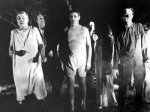
Zombies_NightoftheLivingDeadIn the continuing comparison of natural and supernatural views of reality, we’ve considered some fairly philosophical perspectives. However, for these things to be real, we would expect clear manifestations, some evidence in the natural world. It may or may not be strictly testable, but there should be some ramification. In this essay, we’ll consider an example of what we might expect, drawn from a movie.

The movie of interest, I Am Legend, is not a Christian movie. In fact, it is a secular mass market zombie movie made by mainstream Hollywood. Surprisingly, however, they use several Christian themes as plot elements and we can draw on those to illustrate the point a hand. (Warning: This post contains SPOILERS.). Continue reading

Fossils and the End of Mortality

PaleoLab-thmFossils remind us that mortality has been around for as long as life itself, yet fossils also illustrate immortality. In a sense, these animals continue to exist, almost as humans persist as statues. But there is a big difference: fossils are not just representations of animals — they are the animals themselves, only now with slower and simpler chemistry. For what has really changed about them? Is there any real difference between chemical reactions that are fast and complex, and those that are slow and simple? Is there any real difference between life and death?

Of course! There is far more to life than fancy chemistry, and even more to humanity than natural life. This truth is the beginning of the end of mortality, for mortality itself has an end. The spark that makes us uniquely human exists beyond mortality, although flickering because of this world’s darkness. But what we physically sense is not all of reality, and with open eyes we can see a path beyond. There is one who defeated death, and because of that he is a door onto this path of light, and is himself a pure light into eternity. Christ is the end of mortality.

Of Causality and Love, Faith and Eternity

The world is a mysterious place, and part of human nature is to try to understand it. This is the role of science and rationality; we look to them to help us make sense of things. To an large extent they are very successful, and have improved our ability to manipulate the world more and more. And yet, there are things about the deeper underpinnings of reality that give us pause. Continue reading